Session as part of the Festival des Cinémas Différents et Expérimentaux de Paris.
focus #5 - CONSTITUENT SUPERIMPOSITIONS
An evening programmed and presented by Charlie Hewison – With Marylène Negro in attendance
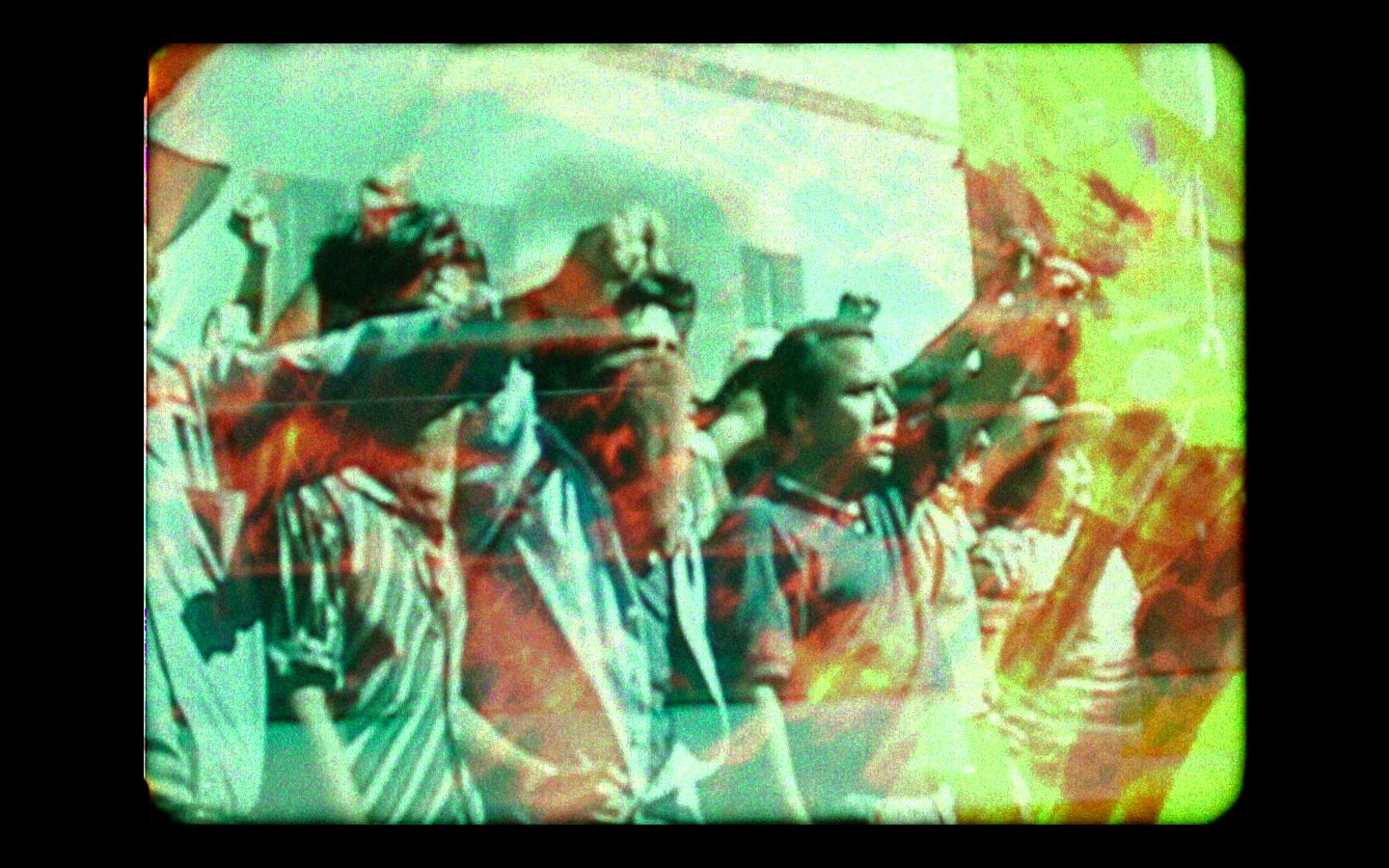
In cinema, superimposition could be understood as the technique best suited to exploring the multiple relationships between singularities and the collective. Images confront one another not sequentially, but within the depth of the frame, forcing us to apprehend each through the others. They do not entirely merge: each persists, while all affect and transform one another. A common field thus emerges, a texture composed of multiple layers. But this does not necessarily imply harmonious coexistence. An image might completely cover another, making it almost imperceptible, forms might lose their contours, faces their individuality. So there’s a tension within superimposition, between appearance and disappearance, differentiation and indiscernibility. Maybe, at the same time, this makes it possible to produce other singularities: of gestures, silhouettes, durations, intensities… Maybe we find out that there are singularities that don’t pre-exist the relation, that must try and survive it intact, but that instead are constituted and reconstituted through it.
Superimposing also opens up the possibility of bringing distant periods and places into contact. Gestures separated by decades or kilometres suddenly occupy the same frame. The dead can inhabit the movements of the living, and a present struggle can become visible through the traces of those that preceded it. Films can thus compose collectives that exceed even the co-presence of bodies, seeking out or inventing recurrences and/or resonances.
Marylène Negro and Colectivo Los Ingrávidos are perhaps the filmmakers in contemporary experimental cinema who have most deeply explored both the aesthetic and political dimensions of superimposition. We’ll see how the Colectivo’s Faces in the Crowd trilogy turns demonstrations commemorating the Tlatelolco massacre into the site of an exploration of collective struggle, the increasing density of which seems to make superimposition progressively more and more necessary. Negro’s Révolution française (rappel), presented here in its Paris premiere, is a continuation of X+ (2010), a film that, according to Nicole Brenez, invented a new form of montage, probing depth as much as breadth, verticality as much as horizontality. Here, the filmmaker superimposes scenes drawn from 95 films about the French Revolution, constituting a reminder of what must be done in the face of the fascisms that are once again on the rise today.
Taken together, the films in this programme explore the powers of superimposition to make cinema a space for experimenting with the conditions under which the collective can appear.


